Peters Education Center Auditorium (West of Save Mart Center in the Student Recreation Center Building)
Discussant: Karen Sperling (Director)
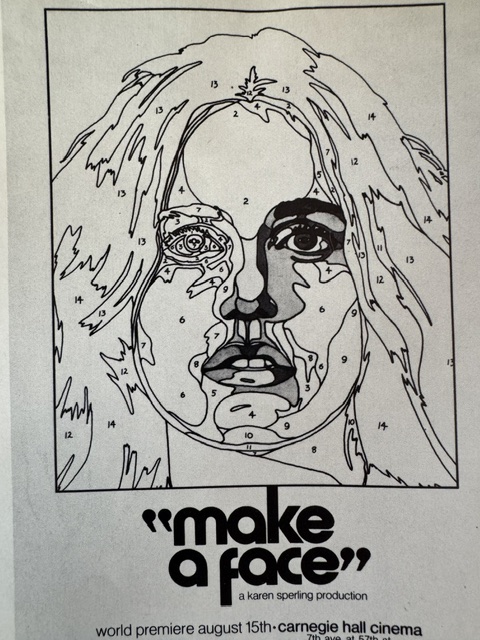
Make a Face is an unplaceable, enigmatic, and evocative psychodrama that follows the director and performer Karen Sperling as the expressionless Nina, an artist in an ostensibly constant state of dissociation. Critics at the time made facile comparisons to Milton Moses Ginsberg’s Coming Apart (1969), Roman Polanski’s Repulsion (1965), and Susan Sontag’s Brother Carl (1971), but Make a Face is more unwieldy than those films. For one thing, it’s in color: muddy swirls of brown, beige, and orange fill every image. If anything pops, it’s because of the grey flickers of a television screen or the scant images of buildings’ white walls. Visually, shadows and bounce lighting transform an apartment into a site of mystique. Sperling is part of the Warner family—the granddaughter of Harry Warner, the daughter of producer Milton Sperling—but her film has little to do with Hollywood sensibilities. Independently funded and utterly audacious, Make a Face is built on ideas from psychiatrist R. D. Laing, constructing an experiential suspense film where “dreams, fantasy, and reality are all equal.” One of the film’s most brilliant tactics is the use of an ever-present radio, telegraphing the world’s many woes. Its never-ending presence becomes something to accept, and the way it casts dread serves as an analogue to our present-day doom-scrolling. There are also innovative scenes with hand-crafted split-screen, offering further tension and disorientation. This is, however, not a film about fact vs. fiction or of docufiction antics: it’s about the way that all these things are connected—the destructive state of the world, the collapsing of our social lives and selves. The film begins with a connect-the-dots game of Nina’s face and concludes with a close-up of it, the lighting in constant motion to blur the contours of her head. It’s unclear what emotion she’s conveying—it feels more honest that way. 90 minutes.
CineCulture club promotes cultural awareness through film and post-screening discussions.
Fresno State encourages persons with disabilities to participate in its programs and activities. If you anticipate needing any type of accommodation, please contact us in advance of your participation.
CineCulture brings films and filmmakers from around the world to share their experiences, visions, and voices with our community. For 18 years, these films and post-discussions with directors, respected guest speakers, and local professors with relevant expertise have fostered and affected intercultural understanding of critical issues that deeply inform our local, national, and international awareness.
Last spring I was notified that CineCulture, like other programs, is facing a significant funding reduction. Much appreciated, grants from Associated Students in the past have gone towards securing performance rights for films (required for community screenings), guest director/artists’ honorariums, travel, and hotel expenses.
This summer, I was informed that screening rights for films can no longer be paid using Associated Students grants I’ve received for the past 18 years. However, thanks to the generous contributions by community members, we can continue screening films and welcome the community! Without your support, CineCulture would have ended last spring. Please accept my heartfelt thanks! It’s an honor and privilege to continue bringing independent and foreign films to our community.
During these challenging times, the films and filmmakers we invite not only educate and inspire us but are, as Harry Belafonte would remind us, “Artists are the gatekeepers of truth.” My hope is that, together, we can gather the support needed to continue this vital, creative international exchange program.
If you’d like to help support CineCulture film screenings and director visits by making a tax-free donation, you can 1) Click on the link at the bottom of this page, follow the steps, and type CineCulture, or 2) Attend a CineCulture screening, use an envelope on the table in the back of the auditorium, and either leave it in the basket or return it by mail.
Every gift makes a + difference!
For further information about CineCulture contact Dr. Mary Husain (Instructor & Club Adviser) at mhusain@csufresno.edu
Help support CineCulture today!
Click here, select “Select a Specific fund,” then click “View all giving opportunities and select other,” then add a donation amount, then, “Please specify where to direct your gift ” type CineCulture.

